Breathalyzer Tests: Definition, How It Works, Types, How to Read, Accuracy

Breathalyzer tests measure blood alcohol concentration (BAC) by analyzing alcohol content in a person’s breath. These tests estimate intoxication by detecting ethanol molecules in exhaled air and converting that measurement into a numerical BAC value.
Breathalyzer tests work by capturing deep lung air and processing alcohol content through electrochemical or infrared technology. Results help assess alcohol consumption for medical, safety, and monitoring purposes.
Key Takeaways
- Breathalyzer tests estimate blood alcohol concentration using breath samples
- Results reflect alcohol presence, not behavioral impairment
- Accuracy varies by device type, calibration, and testing conditions
- Residual mouth alcohol and health factors influence readings
- Repeated high readings indicate risky drinking patterns
What Is a Breathalyzer Test?
A breathalyzer test is a device that estimates blood alcohol concentration by measuring alcohol vapor in exhaled breath.
Unlike wellness practices such as deep breathing exercises, which regulate stress and respiration, breathalyzers analyze alveolar air from the lungs. Alcohol in the bloodstream diffuses into this air, allowing breath measurements to correlate with blood alcohol levels using a standardized 1:2100 breath-to-blood ratio.
The modern breathalyzer was developed in 1954 by Robert Borkenstein, improving earlier alcohol detection tools and allowing objective intoxication assessment outside laboratory settings
How Does a Breathalyzer Test Work?
A breathalyzer test works by indirectly measuring blood alcohol concentration (BAC) through the analysis of alcohol content in exhaled breath. The procedure begins with collecting a deep, sustained breath sample from the lower lungs (alveolar air), as shallow mouth air yields inaccurate results.
In older electrochemical models, the breath sample passes through a potassium dichromate solution, where ethanol reacts with acidic dichromate ions in a redox reaction: ethanol is oxidized to acetic acid, while orange dichromate (Cr₂O₇²⁻) reduces to green chromium ions (Cr³⁺), with the color intensity quantified photoelectrically. Modern devices use fuel cell or infrared spectroscopy technology. Fuel cell breathalyzers oxidize ethanol to produce an electrical current proportional to alcohol concentration, while infrared models detect ethanol’s unique absorption wavelengths. Results are displayed numerically or via color-coded indicators: red (above legal limit, e.g., ≥0.08% BAC), orange (caution range), and green (below limit).
A study compared three consumer breathalyzers (multiuse, two single-use) against a police device. Testing 208 participants in licensed venues, the multiuse showed 89.5% sensitivity, and 64.1% specificity; single-use devices had 94.7%/26.3% sensitivity and 50.6%/97.5% specificity. Self-reported ≤5 UK units exceeded all devices’ sensitivity. Ashdown et al. 2014 concluded in “Diagnostic Accuracy Study of Three Alcohol Breathalysers Marketed for Public Sale” that consumer breathalyzers lack regulatory-mandated sensitivity, risking safety-critical decisions.
What Methods Are Used with Breathalyzer Tests?
Breathalyzer testing methods include Preliminary Alcohol Screening (PAS) and Evidential Breath Tests (EBTs).
PAS devices are portable and provide rapid BAC estimates during roadside or field assessments. EBT devices operate in controlled environments and produce legally and clinically reliable measurements.
The types of breathalyzer tests include:
- Preliminary Alcohol Screening (PAS): Portable devices used during roadside tests to estimate BAC. These are less accurate but provide non-binding (±0.01% accuracy) immediate results to screen for impairment.
- Evidential Breath Tests (EBTs): High-precision devices used in controlled settings (e.g., police stations) to measure BAC with ±0.005% accuracy. Results are legally binding and used as evidence in court.

What Are the Types of Breathalyzer Tests?
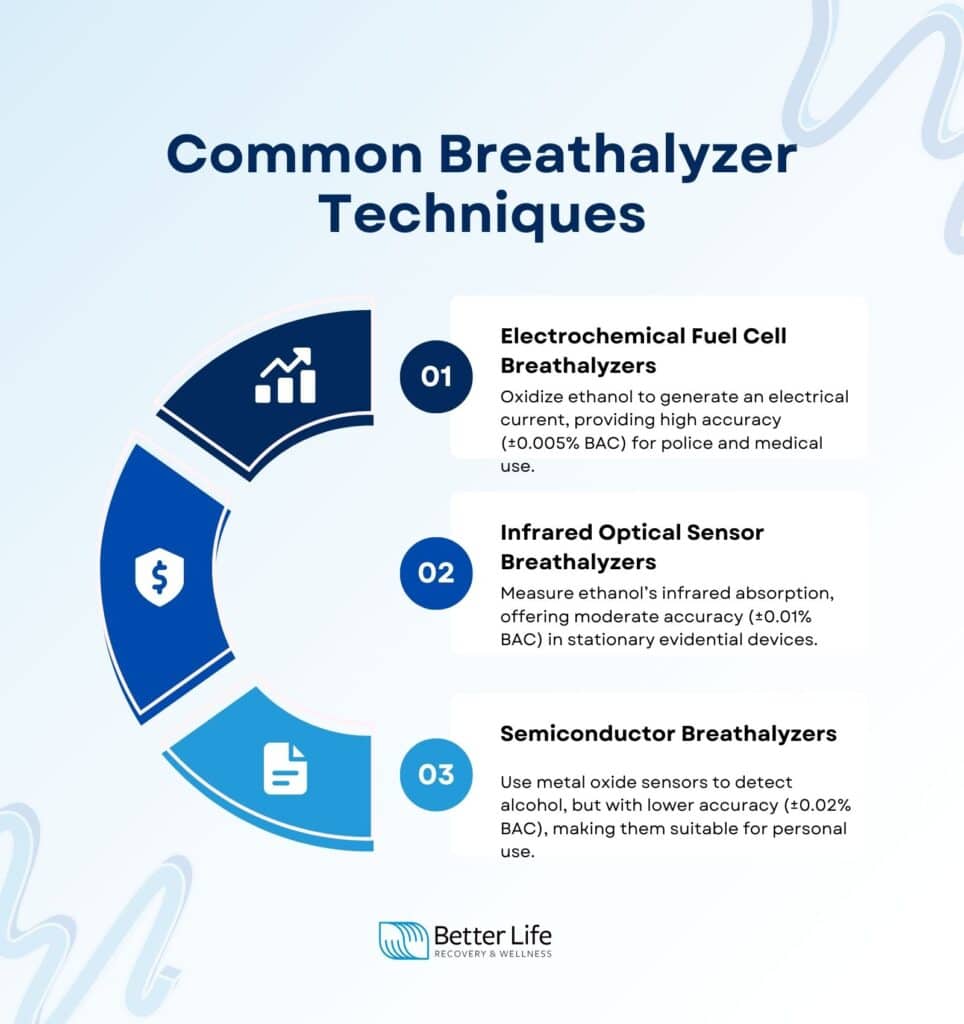
Breathalyzer tests use electrochemical fuel cells, infrared sensors, or semiconductor technology.
Each type differs in precision, cost, and intended use:
- Electrochemical Fuel Cell Breathalyzers: High accuracy and stability, used in law enforcement and medical settings
- Infrared Optical Sensors: Stationary systems detecting ethanol absorption wavelengths
- Semiconductor Breathalyzers: Lower-cost devices with greater variability and environmental sensitivity
How Is a Breathalyzer Test Read?
A breathalyzer test is read as a blood alcohol concentration percentage representing grams of alcohol per 100 milliliters of blood.
In the United States, a BAC of 0.08% represents the legal driving limit for adults. Higher readings correspond with increasing impairment of judgment, coordination, and reaction time.
BAC Levels and Associated Effects
| BAC Level | Effect on Perceptions and Capabilities |
| 0.01–0.05% | Mild relaxation, slight euphoria, reduced inhibition. |
| 0.06–0.10% | Emotional volatility, numbness, impaired coordination/memory. |
| 0.11–0.20% | Mood swings, slurred speech, poor balance, blurred vision. |
| 0.21–0.30% | Aggression, confusion, vomiting, severe motor impairment. |
| 0.31–0.40% | Loss of consciousness, coma risk, suppressed reflexes. |
| 0.41% and over | Respiratory failure, potential fatality. |
What Factors Affect Blood Alcohol Content (BAC) Levels?
Factors that affect Blood Alcohol Content (BAC) levels are gender, body composition, type of drink, stomach contents, and use of other drugs. These elements influence how alcohol is absorbed, distributed, and metabolized, leading to variations in BAC levels even with similar alcohol intake.

Common factors affecting BAC levels include:
- Gender: Women, in practice, have higher BAC levels than men after consuming the same amount of alcohol due to lower water content in the body and hormonal differences.
- Body composition: Individuals with higher body fat percentages experience elevated BAC levels as alcohol does not dissolve in fat, leading to greater concentration in the bloodstream.
- Type of drink: Beverages with higher alcohol content or carbonation (e.g., spirits or champagne) accelerate alcohol absorption, raising BAC levels more briskly.
- Stomach contents: Consuming alcohol on an empty stomach accelerates BAC as the absence of food speeds up alcohol absorption in the digestive system.
- Use of other drugs: Combining alcohol with certain medications or substances augments alcohol’s effects and elevates BAC levels, sometimes dangerously so.
How Accurate Is the Breathalyzer Test?
Breathalyzer tests are approximately 90% accurate, with an error rate of 10%. Breathalyzer tests exhibit an accuracy range of ±0.01% to ±0.02% BAC under optimal conditions, with evidential-grade devices (e.g., fuel cell or infrared models) achieving up to ±0.005% BAC precision. Error rates rise due to physiological factors (e.g., residual mouth alcohol, breathing patterns), environmental interference (e.g., acetone in diabetics), or improper calibration.
Two research summaries, the Transportation Research Board (1987) and Moskowitz and Robinson (1988) concluded that alcohol levels below 0.050% impair driving-related skills. This finding raised concerns among law enforcement regarding the accuracy of Evidential Breath Test (EBT) devices at such low blood alcohol concentration (BAC) levels. A technical note by Frank J. and Flores A. 1989, forwarded by the U.S. Department of Transportation’s National Highway Traffic Safety Administration (NHTSA), aimed to address these concerns.
The study evaluated the accuracy and precision of EBT devices at BAC levels below 0.050%. The results demonstrated that these devices maintain consistent accuracy and precision at BAC levels as low as 0.020%, ensuring their reliability even at reduced concentrations, as initially validated against NHTSA guidelines at 0.050%.
What Causes False Positive Breathalyzer Results?
False positive breathalyzer results occur when substances or conditions interfere with breath alcohol measurement.
Common causes include residual mouth alcohol from recent drinking, alcohol-based mouthwash, breath sprays, or cough syrups. Medical conditions such as acid reflux, diabetes, or ketosis alter breath chemistry and introduce compounds that mimic ethanol. Improper calibration, environmental exposure, or insufficient waiting time before testing also increase inaccurate readings, particularly in consumer-grade devices.
How Long Does a Breathalyzer Detect Alcohol?
A breathalyzer detects alcohol for up to 24 hours, depending on consumption volume and metabolic rate.
Alcohol registers for one to two hours after a single drink, while heavier intake extends detection windows. Hydration, food intake, and liver function influence elimination speed.
The National Institute on Alcohol Abuse and Alcoholism defines binge-level drinking as intake sufficient to reach 0.08% BAC, a threshold linked to elevated accident and health risks. Repeated elevations align with patterns seen in alcohol addiction.
Can a Breathalyzer Detect Drugs?
No, standard breathalyzers cannot detect drugs because they are designed exclusively for ethanol (alcohol) in exhaled breath and cannot reliably identify other drugs (e.g., cannabis, opioids, or stimulants). This limitation arises because most drugs lack volatile compounds in breath at detectable levels, and breathalyzers use ethanol-specific chemical reactions (e.g., fuel cell oxidation) or infrared spectroscopy tuned to alcohol’s molecular structure.
Emerging technologies, such as high-resolution mass spectrometry or specialized sensors, are being researched to detect drug metabolites in breath. Breath contains over 3,500 components, encompassing 800+ volatile organic compounds (VOCs) across 17 classes (e.g., alcohols, ketones), offering unique metabolic “fingerprints” for health monitoring e.g. drug addiction. The article “Mass Spectrometry for Breath Analysis” by Su et al. 2023 reviews advancements in non-invasive breath analysis using ambient mass spectrometry (AMS).
Can Drinking Water Help You Pass a Breathalyzer?
No, drinking water cannot help you pass a breathalyzer because it does not lower blood alcohol concentration (BAC) or adjust breathalyzer results. Breathalyzers measure alcohol in alveolar air, which directly correlates with blood alcohol levels. While hydration temporarily dilutes residual mouth alcohol (e.g., from recent drinking), it does not aggravate alcohol metabolism, which ensues at a fixed rate (~0.015% BAC/hour) via liver enzymes.
What Is the Highest Blood Alcohol Level Ever Recorded?
The highest blood alcohol concentration (BAC) level ever recorded in a surviving individual was 1.374% (13.74 grams of alcohol per liter of blood) in a 40-year-old Polish man found unconscious in Tarnowskiej Woli, Poland, in July 2013 as confirmed by Guinness World Records (2013). This BAC is 17 times the US/UK legal driving limit (0.08%) and exceeds the lethal threshold (≥0.40%) by over threefold. Police initially doubted the result, but hospital tests corroborated the reading. This record pertains to blood testing, not breathalyzer readings.
Can You Test Blood Alcohol Level at Home?
Yes, you can test blood alcohol concentration (BAC) at home using consumer breathalyzers, which pinpoint exhaled breath to approximate BAC. Conversely, these devices (e.g., fuel cell or semiconductor models) are less accurate than evidential-grade tools used by law enforcement, with error margins up to ±0.02% BAC owing to calibration drift, user error, or environmental calibrations.
Are Home Breathalyzers Accurate?
No, most home breathalyzers lack the precision of law enforcement-grade devices, with accuracy oscillating hugely (±0.02–0.05% BAC) attributed to sensor quality (e.g., semiconductor vs. fuel cell), calibration drift, or user error. Consumer models fail to meet forensic standards, especially near legal limits (e.g., 0.08% BAC).
Home breathalyzers are reasonably accurate, but their reliability depends on the quality of the device and how it is utilized. Higher-end models tend to offer more precise readings, while cheaper options are not as consistent. Accuracy is dependent on the calibration of the device, the timing of the test, and the user’s adherence to proper testing procedures. Home breathalyzers do not match the precision of professional-grade devices deployed by law enforcement. They still furnish a reasonable estimate of your blood alcohol content (BAC) for personal use.
Can AUDIT and Breathalyzer Tests Be Used Together in Alcohol Abuse Assessments?
Yes, the Alcohol Use Disorders Identification Test (AUDIT) questionnaire and breathalyzer testing can be used together in alcohol abuse assessments by integrating subjective self-reports (AUDIT) with objective BAC measurements. The AUDIT, developed by the World Health Organization (WHO), screens for risky drinking patterns and dependency symptoms, while breathalyzers serve real-time verification of recent alcohol use.
Can Medical Conditions Affect Breathalyzer Results?
Yes. Conditions like acid reflux, diabetes, and respiratory issues influence breath chemistry and increase the likelihood of inaccurate readings.
Do Breathalyzer Tests Measure Intoxication Or Impairment?
They measure blood alcohol concentration, not behavioral impairment, which varies by tolerance and individual sensitivity.
Do Breathalyzer Tests Work the Same for Everyone?
No. Biological differences such as metabolism, body composition, and health conditions influence breath alcohol readings even with similar alcohol intake.
Share This Post

Better Life Recovery
All author posts
TREATMENTS WE OFFER
Are you covered for treatment?







Better Life Recovery is an approved provider for Blue Shield of California and Magellan, while also accepting many other major insurance carriers.
Check Coverage Now!